nees@UCSBProjects2005 UTexas Liquefaction Testing

USGS, NEHRP and The University of Texas at Austin Induced Liquefaction Testing


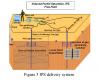
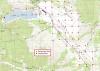
Map with sensor layout at the Array site.
Click for a larger image.

Salton Sea, CA August 12, 2005

A joint experiment between the USGS/NEHRP external grants program (USGS Grant number 04HQGR0073) and the NSF/NEHRP George E. Brown Jr. NEES program (NSF award number CMS-0402490) began this week.

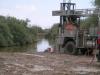
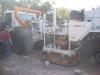
NEES@UTA has been shaking the Wildlife Liquefaction Array site using one of the NEES mobile shakers, recording data on temporary sensors as well as the permanent array at the site operated by NEES@UCSB.

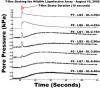
The data that was collected over a two week period will help us improve our understanding of pore pressure generation during ground shaking. This unique data will be used for years to come by researchers and their students developing and improving ground motion simulation techniques that include the effects of pore pressure. Below is a jpeg image of the pore pressure response that we see building up on the NEES permanent field site transducers as the "T-Rex" shakes the site. The top two traces are the permanent array sensors closest to the shaker, the others are further away and also in some cases deeper.


Click image for larger view.

This experiment is a great example of multi-agency and multi-disciplinary collaboration addressing important scientific problems. Through the combined resources of these different agencies and institutions, we are able to accomplish far more. This is a case where the whole is clearly greater than the sum of the parts....

There is a controllable camera located at the WLA site for telepresence viewing. This proved to be a valuable tool for remote collaboration betwen Santa Barbara and the remote site. Take a look at the site through the public video feed link for the Wildlife Liquefaction Array at the web page listed below: http://www.nees.ucsb.edu/telepresence/

A short video clip of the T-Rex shaking at the site during this experiment can be seen here....

Participant Web Links:

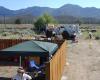
The above image shows the placement of the TRex mobile shaker in relation to the site. The truck will perform a series of shakes along the access road.

Our continued thanks to the High Performance Wireless Research and Educational Network (HPWREN) for their facilities and support that make this research possible.