nees@UCSBProjectsRelated ProjectsHollister Downhole Array

Hollister Downhole Array

Photographs
Interactive Map

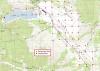
Agbabian Associates installed the Hollister Earthquake Observatory (HEO) in 1991 with funding from the Kajima Engineering and Construction Corp. Kajima Corp donated this array to the University of California, Santa Barbara in January 1998. It is located in the Salinas Valley where alluvium overlies Tertiary sandstone overlying granitic basement (Figures 3 & 4 below). HEO has been operating since early 1992, and is located about 10 kilometers from the San Andreas fault near the cities of Hollister and Salinas in central California. The ground motion array consists of a vertical array of six accelerometers in Quaternary alluvium, and three accelerometers installed at a remote rock station, 3 km to the Northeast. At the HEO main soil station accelerometers are located at 192, 110, 50, 20, 10, and 0 meters depth, going from crystalline rock at the bottom, up through consolidated and unconsolidated alluvium to the surface. Three sensor locations, surface Sandstone, surface Granite, and GL-53 meter borehole Granite are instrumented at the remote rock station. The location of HEO along the San Andreas Fault in Central/Northern California makes it an important addition to the engineering seismology test site program at UCSB. It is complementary to BVDA, and increases our chances of recording a moderate to large earthquake by having state-of-the-art vertical array test sites in multiple seismically active locations. Similar to the BVDA test site, HEO has extensive insitu and laboratory geotechnical site characterization data.

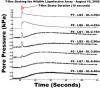
On 12 August 1998, an Mw 5.1 earthquake occurred 13 km almost due east of HEO (Figure 3). All accelerometers recorded the event. In addition to the mainshock, the array recorded one foreshock and at least three aftershocks. The mainshock acceleration time histories for the 180˚ horizontal component are shown in Figure 5. The largest acceleration occurs on the granite outcrop. Note the similarity between the two borehole recordings in rock: GL-192m and Gl-53m. Notice the difference between the two outcrop observations at the remote site (Tertiary and granite), both which could be classified as rock in many attenuation models and used as the rock input motion for driving a nearby soil column. The Tertiary and granite recordings are located approximately 325 meters apart, while the GL-53 and GL-192 recordings are an order of magnitude further apart (3 km) yet are a much more consistent and a better representation of the true input. Even while remaining in the linear strain regime, these records still emphasize the importance of vertical array data.

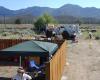
The data from the HEO site are recorded on the previous generation data acquisition systems that are unable to communicate via today's standard network protocols. A main station recording building and remote station recording hut are shown in Photos 1 and 2. In the future we plan to seek funding to upgrade the data acquisition technology at both HEO and BVDA to enable real-time network communications to the sites and quickly get the data into the hands of users via NEES cyber infrastructure.