Borrego Valley Downhole Array
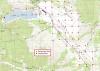
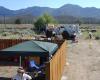
Interactive MapIn 1993, Kajima Engineering and Construction Corp. and Agbabian Associates established the Borrego Valley downhole array (BVDA) near Borrego Springs, in Southern California. In this array there are four borehole instruments extending depths of 9, 19, 139 and 238 m. In addition, BVDA has 15 surface instruments extending in two directions across the Borrego Valley, and a remote rock site at the edge of the valley that includes surface and borehole sensors (Figure 1). At the main station data acquisition systems building (Photo 5) the shear wave velocity gently increases from about 300 m/s at the surface to 750 m/s at 230m - the granite interface - where it jumps to 2500 m/s. The water table is at approximetly 92 m; BVDA is representative of a dry site in NEHRP site class C.
In Figure 2 we show observations of an M 2.4 earthquake at a distance of 7.3 km recorded at BVDA. In addition to the records of the vertical array at the main station, the records from the rock outcrop at station K (Fig. 1) are shown. The soil structure clearly amplifies the motion. Note that the scale is the same for each accelerogram. Amplitudes at the rock outcrop are equal to or larger than those at the surface of the soil site, suggesting that the rock outcrop has amplified the motion. Even dividing by a factor of two we can see that the rock outcrop is still clearly larger than the motion at 238-m depth. This is a clear example of a surface rock station having its own site response. Due to the observed amplification at the remote rock station, a borehole was drilled and logged at station K to characterize the rock outcrop station. S-wave velocity remained between 400-600 m/s to a depth of 25 m where slightly more competent rock was encountered. A borehole sensor was installed at station K at a depth of 30 m. In order to try and obtain a better “rock” borehole station near the remote rock outcrop site without drilling on difficult topography, station J was also drilled, logged, and instrumented. At station J, the transition from sand to decomposed granitic rock (Vs ≈ 1300 m/s) occurs between 50 and 60 m. A borehole sensor was installed at station J at a depth of 91 m.
In addition to the seismic instrumentation the BVDA main station has extensive site characterization data available, including geophysical logging, soil sampling, SPT tests, and dynamic laboratory testing. The rest of the valley has been investigated in detail, Martin, 1999 [7], to provide structure for 3D simulation, Olsen et al., 2000 [8]. Figure 3 shows a 2D cross section of the valley with station locations, the variability in depth to basement, and water table depth shown. Geophysical measurements including gravity and magnetic surveys, and seismic refraction profiles across the valley floor are part of the investment that has previously been made in the detailed characterization of this test site. These data when combined in Martin 1999 [7], provide the detailed 3D structure for the valley shown in Figure 4.