NEESR-SG: High-fidelity site characterization by experimentation, field observation, and inversion based modeling.
NSF CMMI-0619078
PI: Jacobo Bielak
co-PI's: Dominic Assimaki, Loukas Kallivokas, Jamison Steidl, Letecia Velazquez
The main objective of this research is to develop the capability for estimating the geological structure and mechanical properties both of individual sites and of complete basins, and to demonstrate this capability on the nees@UCSB site at the Garner Valley. Specifically, this high-fidelity estimation will be based on integrating: (a) in-situ dynamic excitation using the NEES equipment at the University of Texas at Austin (nees@UTexas); (b) earthquake records from new strong-motion and broadband sensor networks; and (c) new inversion methods based on partial-differential-equation (PDE)-constrained optimization. This project represents an unparalleled opportunity to couple state-of-the-art field experimentation with state-of-the-art computational tools for the purpose of imaging the subsurface at resolutions and length scales until recently unattainable.
Deployment Started at Garner Valley

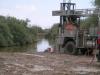
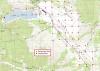
The high density array is taking shape, with a dozen stations in place -- only 48 more to go! (Click to enlarge)
The first stations have been deployed at Garner Valley, beginning in April, 2008. The figure to the right shows the first line in what will be a grid of 60 stations. The stations are spaced 50 meters (164 feet) apart.
The stations captured a 4.2 magnitude earthquake shortly after they were brought online. Vertical traces available here.
November 2007 test deployment near Austin, Texas
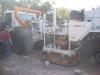
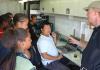
The team of researchers, students and staff next to the Liquidator mobile shaker. With its nearly 6000kg (13,000lb) reaction mass, the Liquidator is able to operate at very low frequencies.
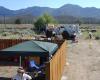
This past November, tests under this project were conducted at the Hornsby Bend biosolid facility in Austin Texas using equipment from both the NEES@UTexas and NEES@UCSB equipment sites. Seismic instruments were deployed along a grid at the surface, and the "liquidator" shaker was used to generate signals that would propagate out through the underlying soils and be recorded by the instruments. This initial test was conducted to improve our understanding of the shaker source capabilities within a range of frequencies from 0.5 to 16 Hz. These tests will help in planning of the future testing to be performed at the NEES@UCSB Garner Valley site.
- Photographs
- Hornsby Bend Testbed Project - UCSB Deployment Grid
- Hornsby Bend Testbed Project - Combined UCSB/UT Deployment Grid
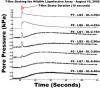
Antelope data acquisition software showing, in the top row, the wave form generated by the Liquidator power signal, and responses of selected surface accelerometers.