nees@UCSBProjectsPilot Experiment in Collaborative Science

A Pilot Experiment in Collaborative Science and Engineering

The 2004 Garner Valley Experiment Working Group

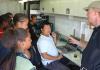
Students from the Black Future Leaders listen to explanation of equipment.

Students from the Black Future Leaders organization inside the nees@ucla mobile seismic laboratroy.

We report on a pilot field experiment, meant to demonstrate the value of combining resources from multiple earthquake science and engineering facilities. Our initial intent was to employ a mobile shaker truck from a Network for Earthquake Engineering System (NEES) facility with US Geological Survey (USGS) and Incorporated Research Institutions for Seismology (IRIS) seismographic instrumentation in a single study. The final experiment grew into four studies with additional participation from the Los Alamos National Lab and other NSF-sponsored consortia; the MAEC, SCEC, CENS, and HPWREN (see Participants below). The field experiment piggybacked on an earlier planned inaugural demonstration of NEES facilities, held at the NEES Garner Valley Digital Array (GVDA) site in southern California.

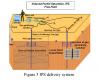
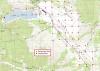
Map of deployed sensors at Garner Valley, California

Sensors will be deployed throughout the Garner Valley to measure soil responses to various waveforms generated by the mobile shaker. Click on the map to view a larger image.

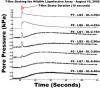
We recorded ground motions generated by the 'TRex' shaker truck at the GVDA and surrounding Garner Valley during August 18-22, 2004 and will continue to collect earthquake data for several months. Our first study tests the potential for generating and measuring nonlinear sediment response by recording TRex strong shaking on a temporary surface accelerometer micro-array and permanent GVDA down-hole accelerometers. Our second study focuses on ground motion site and basin effects by recording TRex signals at 20 temporary real-time, telemetered seismic stations deployed from the center to the edge of the basin. Earthquake signals recorded on this basin array will allow us to validate the process of extrapolating results from the artificial, surface source to those from natural earthquakes. The relatively small scale of the Garner Valley basin (~4 km by 10 km, sediment depths <~25 m) makes its characterization feasible, but scalable to larger basins elsewhere and motivates our third study in which we conduct a variety of imaging experiments. Basin array data will constrain broad-scale shear and compressional wave tomographic images of the basin structure.

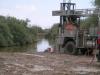
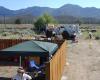
Photo of the T-Rex mobile shaker

The University of Texas at Austin operated the Triaxial Mobil Shaker "T-Rex.

To constrain a higher-resolution image along a profile across the basin, we also collected reflection data generated by TRex recorded on densely spaced geophone strings, and conducted a sledge-hammer survey at even higher resolution to confirm the location of a suspected buried fault. For the fourth study, we assess the potential for shakers like TRex to do broad-scale, deep imaging as we stack TRex signals emitted repeatedly for nearly an hour, recorded on stations of the regional ANZA and statewide California Integrated Seismic Networks.

Participants:

Photographs/Documents:

Made Possible with the Help of HPWREN

Our continued thanks to the High Performance Wireless Research and Educational Network (HPWREN) for their facilities and support that make this research possible.